Number Code 127954863

In recent decades, number codes have appeared in the family of mantras. Opinions about their usefulness vary, just as the authors and energetic backgrounds of these codes vary. For example, we encounter angelic number codes, Grabovoi codes, the healing code of Zhi Cheng Guo, Energy Balancing by Numbers by Lloyd Mear, and others. Chaldean numerology also includes numerical codes, such as the code for activating harmonious energy in name numbers, which I presented a few months ago. There is also a number code derived from the date of birth, introduced by the Chaldean numerologist Alberto Ferrarese.

The code I am offering you for the New Year 2026 is not related to any of the above. It originates from one of my older codes, which I tested with acquaintances as early as 2017. Its numerological foundation is too complex to go into here, as it operates on nine levels and in some places also takes into account the cubing of numbers. The numbers are mentally spoken in the order in which they appear in the code.

The code is:


127954863

Its function is to activate, harmonize, and release the natural circulation of energy in the meridians of the subtle body, and to strengthen this circulation with environmental energy in order to achieve harmonious development. This is not a magic wand, but a tool with limited reach. This numerical mantra must not be repeated continuously without interruption, as doing so destroys its internal structure. Any error in the sequence of numbers also destroys the internal structure. Over time, the structure is likewise destroyed by writing the code down—for example on paper or on one’s own skin—because the digits may begin to add up into a single number (“fadic number,” “vibratory key”).

Mentally focus on the number 1, then on 2, then on 7, and so on until the final number 3. Then interrupt your concentration for at least 10 seconds and relax. The code can be repeated several times in this way.

Happy New Year!

Boštjan

The mantra YA AH HU SHU

The mantra YA AH HU SHU (yah – a-h/ahh – hoo – shoo) originates from the Divine Name Yahu/YHW (יהו). It is practiced mentally, without vocalization. Breathing should be gentle and, if possible, diaphragmatic (abdominal breathing).

With the first three syllables—YA, AH, and HU—we imagine Divine love flowing toward us. During the mental sound YA (yah), we focus on a point approximately 60 cm (about 2 feet) above the head and inhale. With the sound AH (if pronounced aloud, AH would end with an exhalation; one would exhale into the H), we focus on Kether, or the crown chakra. In other practices, the sound AH may also be associated with the nose or the heart chakra, but here it is used at the top of the head. While performing this sound, we hold the breath for a few seconds, if our physical health allows it. During the exhalation, we focus on the chest and on the mental sound HU (hoo).

We do not want the flow of energy to accumulate in the heart or near it, as the heart is a sensitive organ. Therefore, during the breath retention after the exhalation, we use the sound SHU (shoo) and guide the energy downward. A more specific focal point is not necessary here; instead, we pay attention to relaxing the body, especially the lower part, as this sound is intended to promote calming. The state of breath retention after the exhalation should be practiced in accordance with our physical limitations. Some individuals can hold the breath only for a few seconds, and that is also perfectly fine. Others can hold the breath after exhalation for 30 or 40 seconds, or even for several minutes. For most people, it is not recommended to hold the breath for longer than 40 seconds.

The sounds and the breathing cycle may be repeated several times, according to one’s own feeling. If you do not feel well during the practice, stop it. If you do not feel well afterward, you may return to it after some time. If you still do not feel well after the practice, this exercise may not be suitable for you. More detailed background explanations of this practice or of these mantras will not be provided.

Happy Solstice New Year!

The Number 77 and Chaldean Numerology

This image was created by ChatGPT

Traditionally, in Chaldean numerology, this is an unlucky number, governing inner struggles and opponents, unstable success, and rapid changes, and it is considered unpredictable and unfavorable. It is composed of two sevens, and the vibrational key of this number is 5 (7 + 7 = 14; 1 + 4 = 5). Modern Chaldean numerologists often tend to forget that the number 7 is primarily a lunar number, with 7 representing half of the lunar cycle and the number 2 the other half.

Thus, 7 undoubtedly rules change, and the number 5 is also changeable. For this reason, it is very similar to the number 14 and must change its affairs every five years, or even sooner, and be wary of illusions. Periods of great stress are likely; the number may also bring psychological pressure, and there is also a possibility that this number influences a weaker immune system. The reason for all this lies in the many changes, many of which may be unexpected.

In more contemporary approaches, the number is often described in a more favorable light, somewhere between the meanings of the numbers 14 and 23. This raises the question of where modern numerologists obtained the idea that this is a lucky number. I do agree, however, that it is said to confer quite a few talents. With this number, caution is certainly recommended.

Court Cards in Chaldean Tarot – The Intersection of Tradition and the Renaissance

In the previous article, I briefly outlined the connections between tarot cards and numbers. Some connections to Chaldean tradition may seem unusual at first glance, especially among the pips cards, since, for example, all threes of the suits are considered unlucky numbers (29, 43, 57, 71), while the number 3 itself is generally not unlucky. There can be several reasons for this. Among other things, we must consider that these cards are placed within the general numerical sequence from 1 to 78, which corresponds to Chaldean numerology. It should be emphasized that the interpretations of pips revealed by French occultists from the late 18th century differ significantly from the Chaldean tarot. Reconstructing the original tarot, or Chaldean tarot, is therefore a challenge. Regardless of the solutions proposed, it should be noted that in divination, any interpretation works, because the chosen interpretation becomes part of one’s own divinatory matrix. This is a comment from a numerologist who, by the way, does not practice divination 😊.

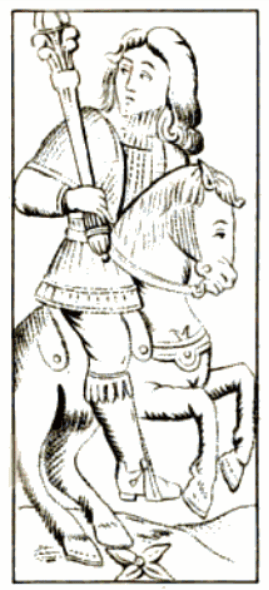
That Chaldean tarot existed in the 15th and 16th centuries is evident, besides the Major Arcana, primarily from the court cards, which consist of Kings, Queens, Knights, and Pages (23, 24, 25, 26, 37, 38, 39, 40, 51, 52, 53, 54, 65, 66, 67 (?) and 68). Kings 23, 37, 51, and 65 are powerful figures. Wands and Cups represent cycles of growth, while Swords and Coins represent cycles of decline. Wands and Swords are active, Cups and Coins are passive.

Thus, the Kings of Wands and Cups are favorable, as they govern the cycle of growth and success. The King of Wands aka Royal Star of Leo (23) is favorable for career, business, and assistance from people in authority, and his Queen is also emotional yet still successful (=24). The Knight of Wands (25) is considered a successful career knight/general, representing good analysis and strategy (this is the meaning of 25). The Page represents the lowest court rank and may also signify challenges and difficulties, for example in career or business (26). Similarly, 37 is the King of Cups aka The Royal Star of the Bull, or the King of Emotions, at the peak of his power—the number signifies favorable relationships, partnerships, etc. The Queen of Cups embodies emotions to the square, which probably is no longer a favorable solution (38). The Knight of Cups is impulsive and sometimes dangerous, as he is a successful commander who can occasionally be misled or betrayed by emotions. Thus, the number can signify both success and difficulties, giving it a more neutral meaning (39). The Page of Cups represents the risk of emotional entanglements and emotional exploitation, and from this perspective is not a favorable number (40).

The Kings of Swords aka The Royal Star of the Waterman (51) and Coins (65) are not necessarily lucky, as the numerical cycle turns downward after 51. The King of Swords, therefore, brings both success and danger in conflict (51), while the Queen of Swords adds a touch of emotion and intrigue—sword and emotions and grudges don’t go well together (52). The Knight of Swords is a sword to the square and in a more exposed position than the King (53). The Page of Swords, due to low rank, is like cannon fodder and in an even worse position (54). The King of Coins aka The Royal Star of Scorpio (65) is also a powerful figure like all kings, but he governs the final phase, which is also a phase of stronger disintegration—wealth must be hidden and protected, and wounds are not excluded. The Queen of Coins (66) is more successful at hiding wealth and in diplomacy, and is therefore generally luckier than the King of Coins. 67 is the Knight of Coins—probably represents danger in tarot as well, but this is the card that is most difficult to interpret using court card symbolism (??). The Page of Coins (68) cannot be a lucky number, as it is the lowest court card and is in an even more disintegrative phase.

THE YEAR 2026 AND CHALDEAN NUMEROLOGY: The Possibility of an End to the Russo-Ukrainian War and a Look Several Years Ahead

This image was generated by ChatGPT

The year 2026 will be influenced by the number 1, as its digits add up to the vibrational key 1. At the same time, lingering influences of the number 9 from the past will still be present. Many people will feel torn this year between the future and the past—between new ideas and plans on one side, and looking back on the other. Wisdom will be required so that we do not continue living in the past. What has been is over; it is necessary to remain open to what is fresh and new. At the same time, we may need to accept that certain matters we believed were already closed will actually need to be fully completed in this year. For people prone to conflict and aggression, 2026 may be particularly demanding, as the transformation from the old to the new can now be accompanied by heightened aggression.

This year will be especially favorable for vibrational keys 5 and 6, as well as 1, 3, and 9. Relationships may be more challenging for vibrational keys 2, 4, and 8. For those with key 7, the influences will be more neutral. In a personal numerological chart, the Total Name Number and the Birth number (the number of the day in  the month) are very likely the main vibrational keys, and these should be compared with the annual influences.

Let us now turn briefly to some aspects of mundane numerology. The reader should be aware that the descriptions are based on certain energetic patterns and are presented without drawing parallels to astrology. Even if some energies suggest that particular types of events could manifest, we can never be completely certain. Through awareness and personal action, many undesirable events can be prevented—and conversely, we can also achieve things that the stars themselves do not promise. It would, of course, be safer to remain solely on the level of describing energetic patterns and their general qualities. Perhaps that is what I will do next year.

Here, however, I will allow myself a few explorations of what the year 2026 may bring, as well as what the years that follow might hold. With 2025, a demanding macro-numerological period comes to an end—one that, in a narrower sense, spans roughly from 2015 to 2025, and in a broader sense may reach back to 2013 or 2014. This period may ultimately represent one of two things, something we will only be able to determine in hindsight. The first possibility is the decline of the era of Islamic fundamentalism, which rose around 2013 with the emergence of the so-called Islamic State (ISIS) and may be coming to an end with the defeat of Hamas in Gaza. The second possibility is the end of the war in Ukraine, which has been ongoing since 2014. A new peace proposal is now also on the table.

Because certain influences from 2025 carry over into 2026, the heightened likelihood of these wars ending is concentrated between the end of 2025 and throughout the first—and possibly the second—third of 2026. Indicators for 2026 suggest a greater probability of the Palestinian crisis continuing, and a lower risk of the Russo-Ukrainian war persisting. Both Ukraine and Russia are exhausted and are therefore more likely to be willing to agree to a ceasefire based on realistic terms. If peace is not established in Gaza, then—at least from the numerological perspective I have access to—we may still be facing another year or two of difficult conditions. In contrast, in Ukraine, even if the war does not formally end, we can expect a certain cooling of the conflict in 2026, with the possibility of renewed escalation in 2027. This makes it all the more important to work actively for peace now.

This year carries an exceptionally strong vibration of the number 1—one of the strongest “ones” of this century. It will bring many business opportunities, opportunities for healers, and opportunities for major life breakthroughs. However, this applies primarily to those who follow what is new and fresh. Individuals and groups that cling to old patterns may encounter financial or professional difficulties, or problems with completing projects. While this advice applies to every year, it is especially emphasized in 2026. Unfortunately, on the global political stage, there is also the possibility that a new major war could erupt—particularly in regions where old patterns are not released quickly enough.

From the perspective of numerological macro-cycles, it is important to recognize that 2026 may also lull us into complacency, as many things will tend to move in a positive direction during this year. Ahead of us lies the period from 2028 to 2032, which signals the possibility of a military conflict—this time in the East. Given current circumstances, this could most likely involve an escalation of the Taiwan issue, but also potentially tensions on the Korean Peninsula, or even relations between China and Japan. Ultimately, China may still carry unresolved issues in its collective consciousness regarding lost northern territories such as the Amur region (the Vladivostok area), Mongolia, and Tuva. At present, however, I do not yet have sufficient numerological clarity on how to assess the relationship between China and Russia.

The probability that China will be involved—directly or indirectly—in whatever conflict may arise, wherever it may occur, is very high. Direct or indirect involvement of the United States is also quite likely. It is difficult to speak about the intensity of such a conflict. Much depends on the maturity of political leaders and the overall level of collective awareness—on people’s willingness to live more love and peace in their own lives. As things stand, the likelihood that the intensity would reach the level of the Russo-Ukrainian war appears relatively low. But are we capable of passing at least this test without war?

Tasks for Spiritual Seekers in 2026:

  • Connecting with the Creator and the field of love;
  • Developing healing abilities, abundance, and the ability to set clear goals—the opportunities for growth in this year are truly extensive;
  • Emphasizing openness to fresh energies and ideas and letting go of old patterns, as well as the need to release aggressive patterns;
  • Engaging in energetic work to help humanity move away from old and aggressive patterns and to introduce innovation without conflict;
  • Emphasizing unity over conflict and division;
  • Engaging in energetic work to help free the planet from war, so that people may live in a more peaceful world.

A Brief History of Name Numerology

Name numerology most likely originates from ancient Egypt. The first known example of its use comes from ancient Assyria. Sargon II, the Assyrian ruler of the 8th century BCE, built a wall in the city of Khorsabad whose total volume corresponded numerically to the value of the king’s own name.

The Greeks called word-based numerology isopsephy. The term derives from the words ἴσοσ (ísos) meaning equal and ψῆφοσ (psêphos) meaning count. Early examples of using the Greek alphabet for analyzing names and phrases date from the 3rd century BCE. Within isopsephy, a distinction between vowels and consonants was already being observed.

Among the Hebrews, name numerology (originally still Chaldean in nature) was known from at least the 1st century CE onward as gematria (גמטריא). The term may have originated from the Greek word for geometry. An early example of Hebrew gematria is the analysis of the name of Emperor Nero, which in Hebrew transcription — NRVN QSR (that is, Neron Caesar) — produces the number 666, the number of the beast and of man. The calculation uses the classical Chaldean “large values” (mispar hechrachi) rather than the later Jewish “great values” system (mispar gadol), which came into use only later, perhaps with the development of classical Jewish Kabbalah.

N (Nun) = נ = 50
R (Resh) = ר = 200
V (Vav) = ו = 6
N (Nun) = נ = 50
Q (Kuf) = ק = 100
S (Samech) = ס = 60
R (Resh) = ר = 200

Total: 50 + 200 + 6 + 50 + 100 + 60 + 200 = 666.

Much later, the word gematria also came to be used for the analysis of Christian names and expressions written in the Greek alphabet — though in reality this represents a Christian adaptation or extension of isopsephy. In late antiquity or the early Middle Ages, India also developed its own systems for encoding names with numbers. The main figure associated with numerology is the Indian scholar Vararuci. The Arabic system analyzed names based on 28 letters and was called ʿilm al-ḥurūf (علم الحروف).

The analysis of names for the purpose of studying human destiny appeared in Europe only around the 16th century. From this period onward, two main schools began to take shape. One is known as the Pythagorean school (which, despite the name, has only limited connection to the original ancient Pythagorean numerology), and the other is the Chaldean school, which is based at least in part on the reconstruction of numerological knowledge once held by the Western Semites.

Both schools went through several stages of development. There are also notable similarities between them, as their traditions influenced each other over time. Name numerology that uses the same type of alphanumeric coding later employed by Cheiro first appeared shortly before his time. However, Cheiro’s interpretive method itself is much older — it incorporates both Tarot symbolism and ancient tradition.

Modern Pythagorean numbering of the English alphabet emerged slightly earlier than Cheiro’s approach, but the method of interpreting names as we know it today took shape within the Pythagorean school only sometime between 1907 and 1930.

Compound Numbers from 10 to 99

Today I’m writing my first and last article in September, as I’ll be unavailable for several weeks. This post discusses compound numbers above 52. In Chaldean numerology, numbers above 9 are usually described only up to the value of 52.

When it comes to numbers higher than that, numerologists often differ quite a lot in their interpretations. Some even just add up the digits in the number—for example, 89 would be interpreted as 8+9=17. Others reverse the digits, claiming that 71 carries the same meaning as 17. But here lies a big trap! The number 34 does not share the same meaning as 43, nor does 25 equal 52. The number 32 is less favorable than 23. The number 31 contains digits that, when reversed, form 13. However, 31 does not carry the meaning of 13! So why should it be any different with numbers above 52? That’s why I advise against using such approaches.

Theoretically, one could also experiment with the extended Cheiro’s rule, which I wrote about in the article: Extended Cheiro’s rule for numbers above 52?

In practice, however, the meanings of numbers are usually as follows:

Favorable numbers:

19 (but sometimes not lucky), 21, 23, 24, 25, 27, 30, 33,

34, 36, 37 (but sometimes not lucky), 41, 42, 45, 46, 50,

60, 63, 66, 67 (but sometimes not lucky), 69, 72, 73, 74,

79, 91, 96

Numbers that, in relation to other numbers, generate favorable or unfavorable influences:

10, 13, 15, 17, 20, 40, 51, 55,

65, 68, 70, 78, 80, 90, 97, 98,

99

Unfavorable numbers:

11, 12, 14, 16, 18, 22, 26, 28,

29, 31, 32, 35, 38, 39, 43, 44,

47, 48, 49, 52, 53, 54, 56, 57,

58, 59, 61, 62, 64, 71, 75, 76,

77, 81, 82, 83, 84, 85, 86, 87,

88, 89, 92, 93, 94, 95.

Bridge Number as a Method of Determining the Total Name Number

The strongest technique for combining numbers in Chaldean name numerology is not addition, but rather the composition of digits.

Let’s recall: name numbers can be added by first reducing each number to a single digit. If needed, this step can be repeated. For example, in the name number 17, we add the digits 1 and 7 to get 8. In the surname number 38, we add 3+8 to get 11, and then 1+1 to get 2. Finally, we add 8 and 2 together, which gives us 10 as the Total Name Number (TNN).

Another way to calculate the TNN is to keep the numbers as they are and add them directly in a single step. In this case, 17 + 38 = 55.

The Bridge Number, on the other hand, is formed by reducing both the first name and surname each to a single digit. In our example, 17 reduces to 8, and 38 reduces to 2. Then we combine these digits, 8 and 2, into the Bridge Number 82.

In modern numerology, this method was briefly revealed by Cheiro, who in one example combined the numbers 6 and 9 into 69, though in reality this is a very old technique. Today, some Chaldean numerologists are once again using it more frequently.

When calculating the TNN, the other two techniques described above are still active in the background. So, in addition to the Bridge Number 82, the numbers 10 and 55 also exert a weaker influence.

Challenges with the Bridge Number technique:

  • Most Chaldean numerologists do not have reliable interpretations for numbers above 52.
  • The Bridge Number may function somewhat differently than an ordinary number. For instance, a TNN with a Bridge Number 34 from the name 21 and surname 13 is not particularly favorable.

I personally call this number the Bridge Number, to emphasize its role in connecting two numbers into a new entity, like a bridge between them. However, it could also be referred to with other terms, such as:

  • Contact Number, because it represents the contact of two energies that touch and create a new number.
  • Link Number, since the two numbers “link” together into a new entity.
  • Intermediary Number, because it serves as a mediator between two base numbers. It is neither the initial reduction of the name or surname, nor the final single-digit number.
  • Core Expression Number, since it expresses the essence of how two numbers work together within the TNN.

More Than Three Name Numbers in Given Names or Surnames?

This is a very common situation in many countries. The first thing to remember is that in the Chaldean numerology the names by which a person is most widely known carry the strongest energetic effect. For example, Donald John Trump is universally recognized simply as Donald Trump. Therefore, his primary vibrations are analyzed under that form.

That said, there are cases where someone is genuinely called by two given names or two surnames.

If a person has three or more name numbers—say, two given names and one surname—the same rules apply as with just one given name and one surname. The only difference is that creating the Total Name Number (TNN) involves one extra step.

For example: John Michael Wilson → numbers are 18, 22, and 25.

  1. First, we combine the given names:
    • John = 1+7+5+5 = 18 → 1+8 = 9
    • Michael = 4+1+3+5+1+5+3 = 22 → 2+2 = 4
      Together, they form the “combined number” of the given names: 94. This number has its own meaning, but it also reduces to 4.
  2. Next, we add the reduced value of the surname:
    • Wilson = 6+1+3+3+7+5 = 25 → 2+5 = 7.
      Combining the reduced value of “combined number” of  the given names (4) with the surname (7) gives us 47. This becomes the strongest number for this person.

Of course, other influences are also active in the background, such as:

  • 18 + 22 + 25 = 65
  • 9 + 4 + 7 = 20

These “combined numbers” may also include more than two given names, or more than two surnames.

In Search of the Compound TNN and Active Compound Number

What should we do in Chaldean numerology if a first name or surname reduces to a value below 10? Does that mean it carries no special meaning compared to compound numbers? The Danish (post-Chaldean) school approaches this with a method they call augmentation.

Others, however, take the name exactly as it is. I follow this second approach: even if a first name is a single digit, I don’t add anything to it. That name still has its own unique vibration—similar to how Tarot cards from I to IX carry distinct symbolic meaning.

What matters more is how the Total Name Number (TNN) is formed by adding the reduced values of the first name and surname into a complete number.

For example:

  • Al Snow → AL = 1+3 = 4; SNOW = 3+5+7+6 = 21 → 3.
  • 4 + 3 = 7, not a compound number!

Now we check the day of birth. If Al was born on the 3rd of the month, then 7 + 3 = 10. This is not the TNN itself, but it becomes a very active (compound) number, often even stronger than the TNN. However, this only works if the birthday is between the 1st and the 9th of the month.

If the birthday falls after the 9th, this method doesn’t apply. Still, the TNN is active in the background, since it is always created as a two-digit number from the full values of the name and surname. In this case: 4 and 3 combine to form 43 (with an additional influence from 4 + 21 = 25).

If the birthday is the 10th or later in the month, and the sum of the reduced first name and surname is below 10, we can move to the next step by adding the unreduced values of the first name and surname.

For Al Snow: 4 + 21 = 25. But the leading number still remains 43, created by combining the unreduced values of the name and surname.